
Why they matter more than many people realise
People often assume that because an exhibition is free to enter, it must be free to run. I wish that were true.
The Longest Yarn® has always been about accessibility. We want everyone to be able to walk in, take their time, absorb the stories, and feel something — without a barrier at the door. That principle matters deeply to me, and it always will.
But behind the scenes, nothing about this project is free.
Every exhibition you see has travelled. Every panel has been packed, moved, insured, installed, checked, and eventually taken down again. Volunteers give their time generously, but there are costs that goodwill alone cannot cover. There is paperwork, administration, storage, logistics, and an ever-growing list of practical realities that come with running a project of this scale — in more than one country.
It’s also important to understand how venues work.
Cathedrals, churches and heritage buildings host exhibitions like The Longest Yarn® because they need to attract visitors in order to survive. They rely on footfall to help fund the upkeep of historic buildings, daily running costs, staff, and community services. When visitors make a donation at the door, that money usually goes to the venue — not to us.
This often comes as a surprise.
Many visitors quite reasonably assume that their donation supports The Longest Yarn®. In reality, it helps keep the roof on, the lights on, and the doors open at the building you are visiting. Some venues do choose to share a portion of donations with us, and we are very grateful when they do — but this is not automatic and depends entirely on individual agreements.
Because of this, the exhibition itself has to find other ways to fund its own survival.
For a long time, the books quietly carried that responsibility.
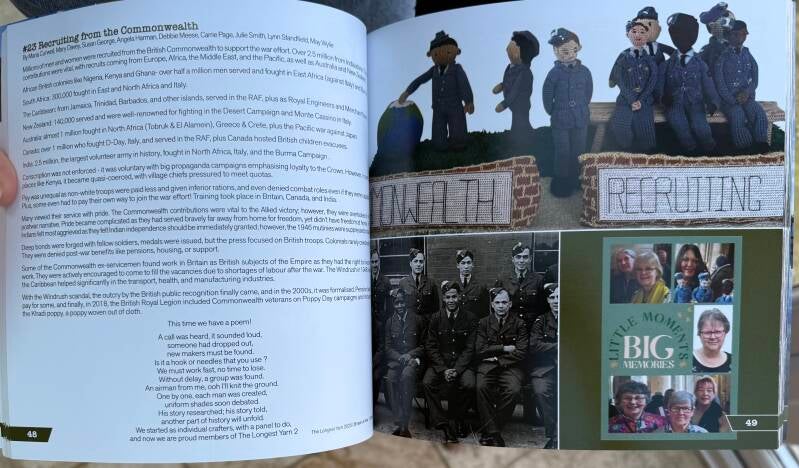
They were never meant to be souvenirs in the traditional sense. They were created to tell the stories more fully, to let visitors take something meaningful home, and — crucially — to fund the work that visitors don’t see. They also showcase the makers: the knitters and crocheters behind the panels, their photographs, and their own words about why they chose to be involved. The book is where both the stories and the people who made them are properly recorded and honoured.
When someone buys a book, they aren’t just buying pages. They are directly supporting The Longest Yarn® itself — the transport, the insurance, the storage, the administration, and the ability to continue touring while remaining free at the door. They are also helping ensure that the makers’ contributions are acknowledged, preserved, and shared.
This year, that balance has shifted.
Fewer books are leaving the table, and that has forced us to confront an uncomfortable truth: without book sales, the exhibition becomes fragile. It doesn’t mean the work isn’t valued — the comments in the visitors’ books tell us otherwise — but appreciation alone does not cover the real costs of keeping this project alive.
This isn’t about pressure or guilt. It’s about clarity.
If you’ve visited The Longest Yarn® and felt that it mattered, the book is one of the most direct ways you can help. Donations at the door support the venue. Book sales support the exhibition itself. Both are important — but they do very different things.
We are immensely proud of what has been created — by hundreds of hands and countless hours of care. The stories deserve to keep travelling. The makers deserve to be seen. And the project deserves a sustainable future.
The books are how that happens.
Thank you for being part of the journey.
FAQ's
Does my donation at the door go to The Longest Yarn®?
Usually, no. Donations made on entry normally go to the venue hosting the exhibition, helping them maintain and run their historic building.
Do any venues share donations with you?
Some do, and we are very grateful when they choose to share. However, this is not automatic and depends on individual agreements with each venue.
Why don’t venues automatically pass donations on?
Venues rely on visitor donations to survive. Hosting exhibitions helps them attract footfall and funding for their own running costs.
So how is The Longest Yarn® funded?
Primarily through book sales and a small number of carefully chosen fundraising activities.
Why is the book so important?
The book directly supports the exhibition itself. It helps cover transport, insurance, storage, administration, and allows us to continue touring while keeping the exhibition free to enter.
What’s inside the book?
Alongside the stories told in yarn, the book features the makers — their photographs, their work, and their reasons for being involved — preserving the human heart of the project.
If I loved the exhibition, what’s the best way to help?
Buying the book is one of the simplest and most effective ways to support The Longest Yarn® and ensure it can continue.
Add comment
Comments